
Punctate leukonychia after nail polish is a superficial keratin condition whose frequency increases with the widespread use of semi-permanent applications and UV gels. In practice, we observe that most of these white spots indicate mechanical or chemical damage to the nail plate, not a systemic pathology. Understanding the precise mechanism allows us to distinguish a benign artifact from a sign that warrants a dermatological opinion.
Disrupted keratinization and micro-damage to the nail plate
The nail plate is made up of layers of hard keratin whose cohesion depends on a minimal hydration level and intact disulfide bonds. When an aggressive solvent (concentrated acetone, acid primer) or excessive filing alters these bonds, micro-pockets of air form between the keratin layers. It is these gas inclusions that diffuse light and create the characteristic opaque white appearance of leukonychia.
The phenomenon often appears after the removal of a gel or semi-permanent polish when one forces the removal instead of allowing the product to dissolve. The dorsal layer of the nail is then partially torn away, leaving an irregular, porous, and dehydrated surface. These micro-tears of the dorsal layer are the primary cause of post-removal white spots.
We recommend examining the spot with a magnifying glass: a superficial leukonychia disappears if a drop of water or oil is applied to the area, as the liquid temporarily fills the air pockets. If the spot persists despite humidification, the damage reaches the deeper layers of the plate, indicating a different diagnosis.
The phenomenon of a white spot on the nail after semi-permanent or gel polish concerns both fingernails and toenails, the latter often being neglected during removal.
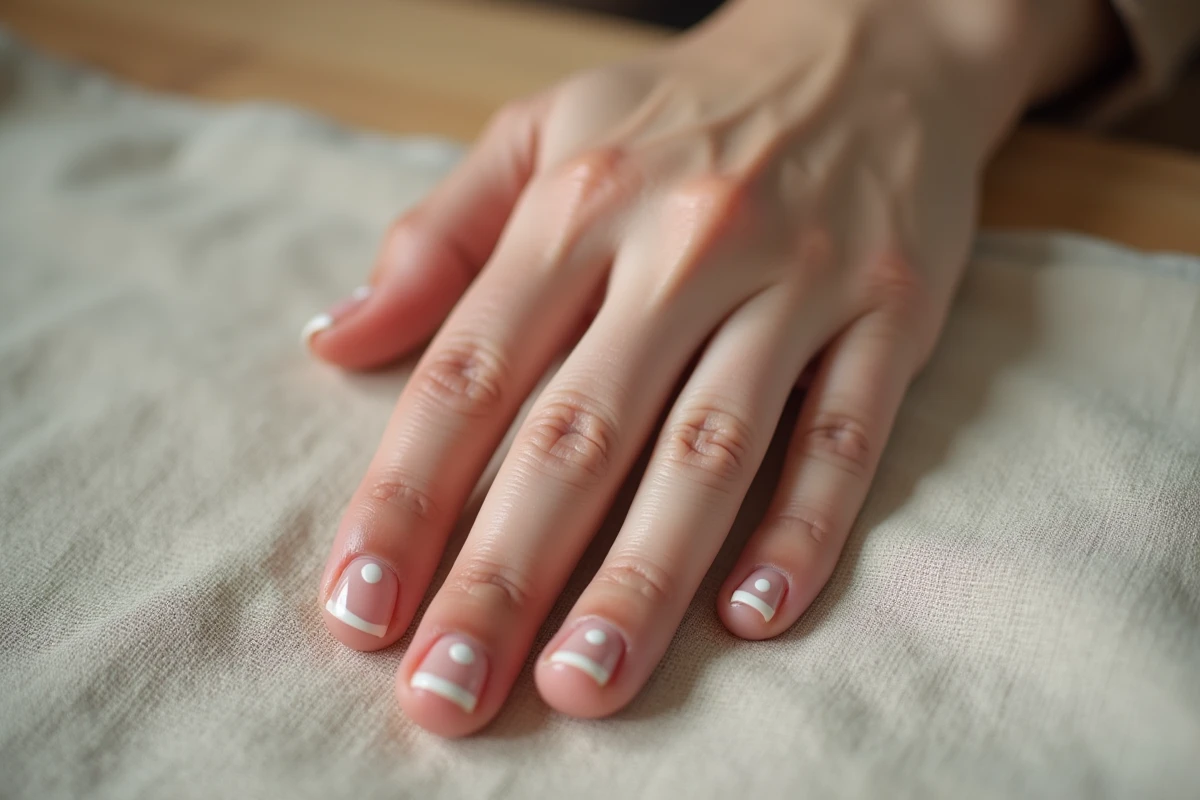
Post-polish leukonychia and nail fungus: distinguishing criteria
Confusion between benign leukonychia and early onychomycosis is common, even among nail professionals. Both produce a white area on the plate, but their characteristics diverge on several points.
- Post-polish punctate leukonychia: well-defined spot, smooth surface to the touch, no thickening or change in peripheral texture. The spot migrates toward the free edge as it grows out and eventually disappears.
- Superficial white onychomycosis: the white area is crumbly, the surface becomes rough or powdery when scratched. It does not migrate with growth; it spreads laterally or deeper. A progressive thickening of the plate often accompanies the picture.
- Total or subtotal leukonychia: the entire nail appears opaque white. This rare form may signal a systemic condition (liver, kidney) or nail psoriasis. It warrants a rapid dermatological opinion.
A dermatologist can make a decision in a few minutes through dermoscopic examination or mycological sampling. We find that many patients wait several months before consulting, sometimes allowing an early fungal infection to establish.
The persistent myth of calcium deficiency
Isolated white spots are not a sign of calcium or iron deficiency. This popular belief is still widely circulated on social media, but it has been contradicted by a study conducted in the UK on a group of students: no correlation was found between the number of white spots and calcium intake.
Punctate leukonychia in adults is almost exclusively of traumatic origin (shock, aggressive manicure, forced removal). In children, they are even more common: repeated micro-shocks to the matrix during play are enough to produce these spots without any nutritional significance.
Supplementing with calcium or zinc in the face of simple punctate spots has no basis. However, diffuse nail fragility (brittle, ridged, soft nails) associated with other clinical signs (fatigue, hair loss) may indicate the need for a blood test, but this picture goes far beyond isolated leukonychia.

Regrowth time and actual timing of the white spot
A fingernail takes about four to six months to completely renew from the matrix to the free edge. The visible spot today results from damage that potentially occurred several weeks or even months before its appearance in the middle of the plate. This time lag explains why some patients discover the spot after an application that is not to blame: the trauma often dates back to the previous removal, not the current application.
This point is rarely addressed in public content, and it alters the analysis of the problem. Blaming the polish removed the day before for causing a spot located in the center of the nail makes no chronological sense. One must look back to the action performed on the matrix or the proximal third of the plate, a few weeks earlier.
Prevention of leukonychia during applications and removals
Prevention relies on protecting the dorsal layer of keratin. A few technical principles significantly reduce the risk.
- Prefer removal by soaking in an appropriate solvent rather than complete filing. Filing should only remove the product, never touch the natural plate.
- Apply a mild dehydrator (and not a strong acid primer) before application: this limits aggressive penetration into the superficial layers of keratin.
- Space out applications to allow the plate to rehydrate. A nail kept permanently under gel or semi-permanent for months gradually loses its flexibility and cohesion.
- Moisturize the cuticle and plate with an oil (jojoba, castor) between applications to restore the surface lipid film.
When white spots are already present, the only solution is to wait for complete regrowth. No topical treatment can erase a leukonychia established in the thickness of the plate. Cosmetic products marketed as “white spot correctors” mask the problem without solving it.
If the spot does not migrate toward the free edge after several weeks, if it thickens, or if the nail changes texture, a mycological sample from the dermatologist remains the next step. For everything else, natural regrowth does the job.