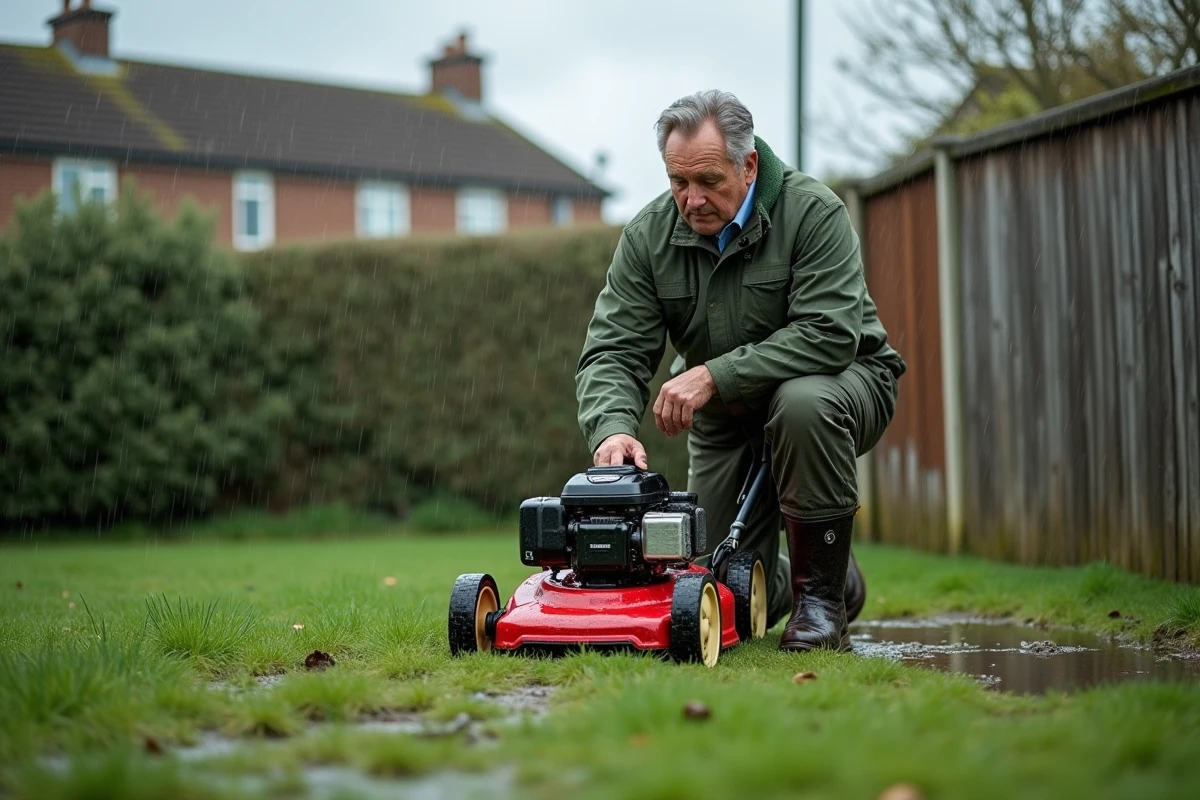
On Saturday morning, the rain has just stopped, the grass has grown three centimeters in a week, and the weather forecast predicts dry conditions for only a few hours. We grab the mower, pull the starter, and find ourselves pushing a machine that clogs, skids, and leaves ruts in the ground.
This scenario is something most garden owners have experienced at least once in spring. Before taking out the equipment after a downpour, a few technical guidelines can help avoid damaging both the grass and the mower.
The Foot Test: Knowing if the Soil is Ready Before Taking Out the Mower
We often talk about waiting for the grass to be dry on the surface, but the real criterion lies deeper. If the soil sinks underfoot, mowing must wait. Grass can visually appear dry while the soil beneath remains saturated, especially in clay soils or shaded areas.
Walk on the lawn with flat shoes. If your footprint remains visible or if water wells up around the sole, the soil hasn’t had time to dry thoroughly. Mowing at this stage compacts the soil under the weight of the machine, which reduces root aeration and encourages moss growth in the medium term.
One might wonder if one can mow the lawn after the rain by relying solely on the feel of the blades, but it is the soil that decides. On well-drained sandy ground, a few hours of sunshine are often enough. On heavy soil, it may take one to two days of dry weather.
Mowing Slot After Rain: Late Morning or Early Afternoon
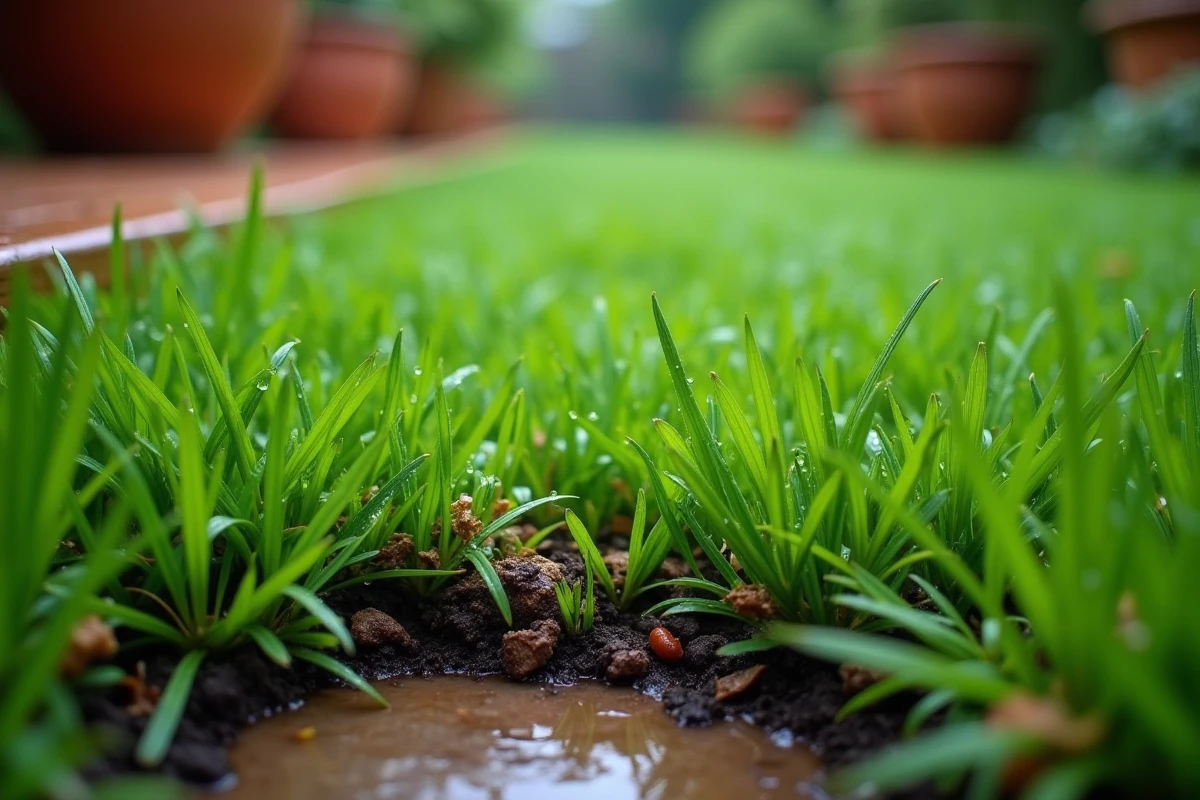
The time of day is as important as the apparent state of the grass. Morning dew adds an extra layer of moisture, even if the rain was the day before. Mowing late in the morning, once the dew has evaporated, offers the best compromise between dried soil and upright blades.
In the evening, nighttime humidity begins to settle, and the cut wounds remain open in a humid environment. This context facilitates the development of fungal diseases on lawns. Pathogenic fungi thrive precisely on these fresh wounds combined with stagnant moisture.
Adjusting Cutting Height When the Grass Has Grown Too Tall
After several days of rain, the grass may have significantly exceeded its usual height. The temptation to cut it all down at once is strong, but cutting more than a third of the blade height in one pass stresses the grass. This results in rapid yellowing and sparse areas.
Raise the cutting height by one or two notches during the first mowing, then come back a few days later to the desired setting. This two-pass approach takes a bit more time but preserves the density of the grass, especially in spring when growth is most active.
What Wet Grass Does to the Mower
Wet grass doesn’t cut; it tears. The wet blades bend under the blade instead of being cleanly severed. The visible result: frayed ends that turn brown in one or two days. The mechanical result is equally problematic.
- Grass clippings stick under the deck and form compact clumps that block the discharge, forcing the motor to work harder continuously.
- The blades lose their sharpness faster because they work against a material that adheres instead of detaching cleanly.
- Clumps of grass that accumulate fall back onto the lawn in piles that suffocate the grass below if not collected quickly.
- On corded or battery-powered mowers, the extra effort reduces battery life or causes the motor to overheat.
Cleaning the deck after each wet mowing limits damage but does not compensate for poor-quality cutting. If mowing on slightly wet grass is absolutely necessary, emptying the bag more often and moving slowly reduces clogging.

Mowing After Overseeding or Reseeding: A Stricter Schedule
The situation becomes more complicated when grass has been recently seeded and the rain has just helped germination. The young shoots are fragile, and mowing too early can uproot seedlings whose roots are not yet anchored.
Wait for the new blades to reach about 7 to 10 cm before the first cut is a precaution that changes the final result. Depending on the conditions, this generally represents two to four weeks after seeding. The soil should be firm underfoot, and the roots sufficiently developed to withstand the suction of the blade.
During this first mowing post-overseeding, only cut the top third, with well-sharpened blades. A dull blade tears instead of cuts, which is even more damaging to young plants than to established grass.
Special Case of Robotic Mowers
Some recent models have a waterproof rating that allows them to operate under light rain. The machine withstands water, but the cutting quality on wet grass remains inferior to mowing on dry grass.
Residues stick to the blades and chassis, requiring more frequent maintenance. Programming the robot to mow in the early afternoon, after the dew has evaporated, remains the most effective setup.
Lawn Damaged by Heavy Rain: The Actions That Really Matter
Prolonged rains pose more than just a mowing schedule problem. Excess water compacts the soil, promotes moss growth, and can cause grass yellowing due to root suffocation.
- Aerate the soil with a spike or core aerator as soon as the ground is dry enough not to turn to mud.
- Avoid any fertilizer application while the soil is saturated, as nutrients would be leached away without benefiting the roots.
- Scarify in spring or early autumn to remove thatch that traps moisture on the surface and suffocates young shoots.
The grass recovers better from intense rainy episodes when given time to breathe before resuming a normal mowing rhythm. Gradually resuming mowing, while raising the cutting height, helps the blades rebuild their reserves before summer.
A lawn mowed at the right time, on firm soil, and with a sharp blade absorbs weather fluctuations much better than a lawn battered by hasty mowings on soaked ground. The mowing schedule adapts to the weather, not the other way around.