
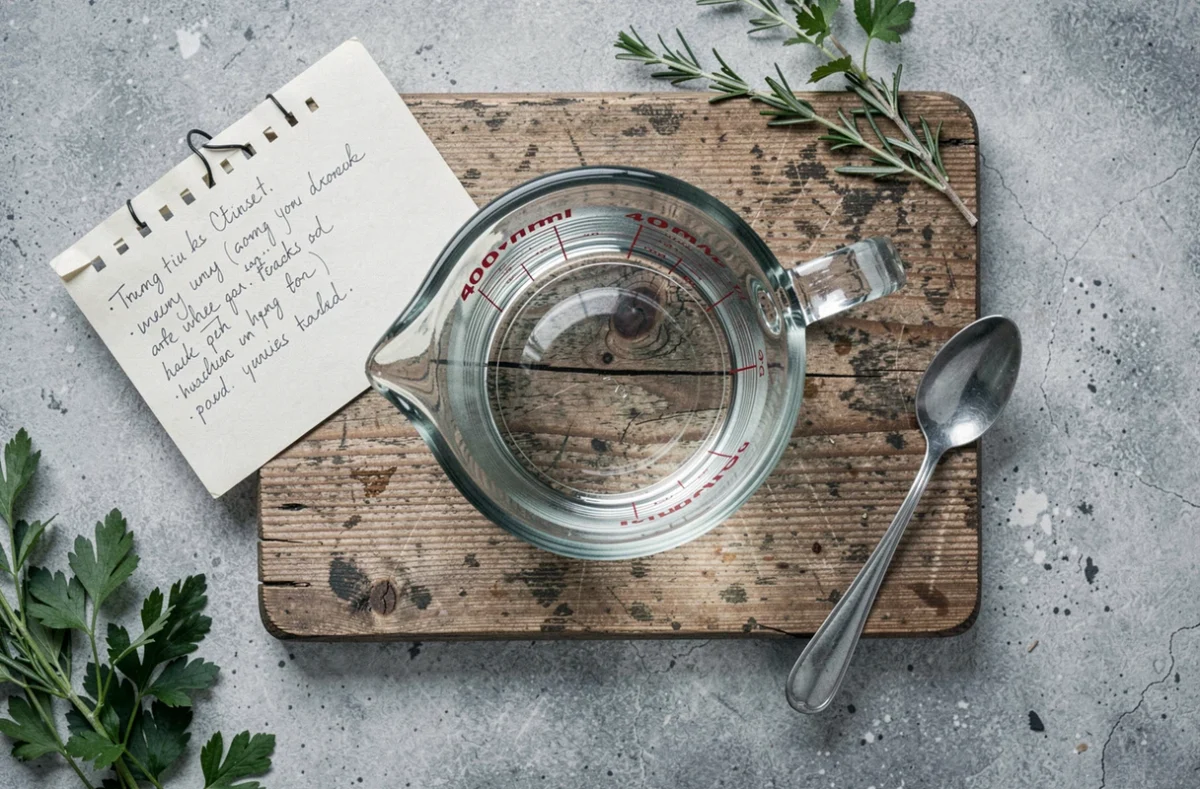
In the kitchen, French recipes switch between centilitres and millilitres depending on the author, edition and format. When a recipe calls for 40 cl of stock or milk, the measuring jug on the counter may show only millilitres.
Converting between these two units is based on the decimal metric system, where moving from one prefix to another involves a factor of ten. 40 cl is equivalent to 400 ml, a straightforward conversion that requires no complex calculations.
Volume and weight in the kitchen: a mix-up that can change the result
Most competing articles cover the conversion rule itself in detail. But one point that rarely gets attention is worth considering: the difference between volume and weight, which often trips up people cooking from recipes they find online.
Millilitres measure volume. Grams measure weight. For pure water, the two are almost equivalent: 400 ml weighs about 400 g. That is not the case with milk, oil or honey. Oil is less dense than water, while honey is much denser. 400 ml of oil does not weigh 400 g, and pouring 400 ml of honey into a bowl gives you a considerably greater weight.
When a recipe calls for “40 cl of single cream,” it means a volume. Mentally replacing “40 cl” with “400 g” works reasonably well for water or semi-skimmed milk, but creates a measurable difference with denser or lighter ingredients.
To convert 40 cl to ml, the rule is always to multiply by ten, whatever the ingredient. The potential pitfall comes when you then try to convert that volume into grams on a scale.
How to remember the cl-to-ml conversion without a chart
The formula fits in one sentence: multiply the number of centilitres by ten to get the number of millilitres. 1 cl = 10 ml, so 40 cl = 400 ml. To convert the other way, divide the millilitres by ten to get centilitres.
The most reliable way to remember this is to keep the structure of a litre in mind:
- One litre contains 100 centilitres and 1,000 millilitres, placing the centilitre one step above the millilitre on the metric scale.
- Converting cl to ml means moving the decimal point one place to the right (or adding a zero to a whole number).
- Converting ml to cl means moving the decimal point one place to the left.
This decimal-point shift works for any amount, not just 40 cl. A recipe calling for 2.5 cl of vanilla extract needs 25 ml. Another calling for 75 ml of rum is equivalent to 7.5 cl.
When the measuring jug and the recipe use different units
A common problem in many kitchens is that the measuring container does not show the same units as the recipe. Some French measuring jugs have graduations in centilitres and millilitres side by side. Others, particularly those sold with food processors, show only millilitres.
Read the liquid level at eye level to get an accurate measurement. Viewed from above, the meniscus (the curve formed where the liquid meets the glass) can distort the reading, sometimes by several millilitres. For a 400 ml measurement, the difference is negligible. For 20 or 30 ml of lemon juice, it can affect the flavour of the dish.
What about foreign recipes?
Anglo-Saxon recipes use the “cup” as a unit of volume. A US cup and a metric cup do not represent the same volume. Before converting centilitres to millilitres, check that the recipe uses the metric system. A US “cup” is not 250 ml, as quick conversion guides often claim: the difference is small, but enough to affect baking where proportions matter.
Baking and precision: why scales are more reliable than measuring jugs
Converting 40 cl to ml solves a unit problem, not a precision problem. In baking, where the ratios of flour, liquid and fat determine the final texture, volume measurements have their limits.
Flour is a good example of this challenge. The same volume of flour can contain very different amounts depending on how it is scooped. Dipping a measuring cup into the bag packs the flour down, so more fits in than if you spoon it in. Two people measuring “150 ml of flour” may end up with different weights.
For liquids such as water, milk or cream, a measuring jug is a suitable tool. The cl/ml conversion applies without qualification. For dry or viscous ingredients, weighing them on a scale gives consistent results every time.
Which ingredients to measure by volume and which to weigh
- Water, milk, cream, stock: measuring in millilitres or centilitres works well because their density is close to that of water.
- Oil, vinegar, fruit juice: volume measurements are still acceptable, even though their density differs slightly.
- Flour, icing sugar, cocoa powder: scales provide considerably greater accuracy than a measuring jug.
- Honey, maple syrup, tomato paste: these viscous ingredients cling to the sides of the container, making the volume reading less accurate.

Remembering that 40 cl equals 400 ml takes just one simple habit: multiply by ten. In the kitchen, the real source of error is rarely the conversion itself, but rather converting volume to weight or reading the measuring jug inaccurately. A clearly marked measuring jug, reading at eye level and using scales for dry ingredients will cover almost every situation you encounter in the kitchen.