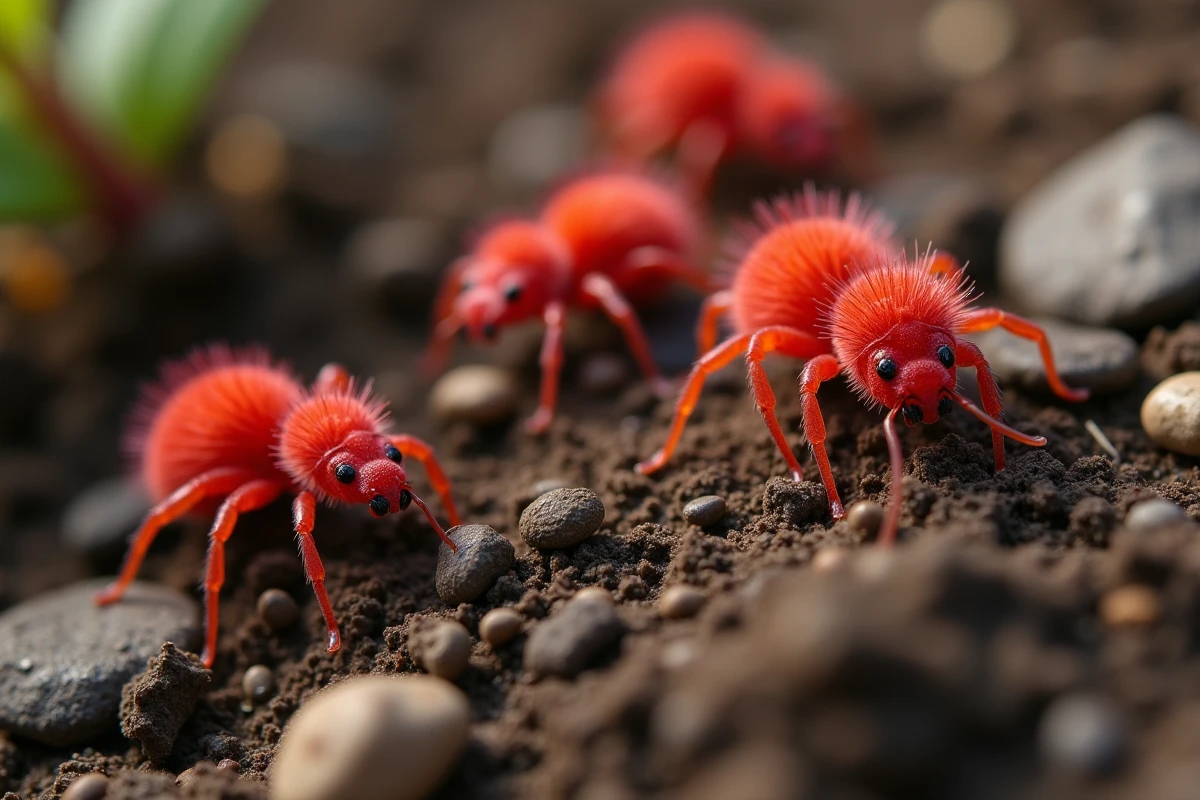
Have you ever noticed those tiny red dots moving on a wall, the edge of a window, or the top of a rose leaf? The first instinct is often to crush them. They are small, they swarm, they seem suspicious. The problem is that under the label “little red creature,” we group at least two types of mites with opposing roles in a garden.
Velvet mite or spider mite: two red creatures, two roles in the garden
The distinction matters more than anything else. The red velvet mite (Trombidium holosericeum) is a predator. It feeds on insect eggs, larvae, and small pests. It is part of the garden’s helpers, just like ladybugs or lacewings.
The spider mite (Tetranychus urticae), on the other hand, is a pest. It pierces the leaf cells to suck out their contents. The leaves turn yellow, dry out, and fine webs appear on the underside of the foliage.
Visually, the confusion is easy. Both are red, both measure less than a millimeter. Before wondering should we eliminate the little red creatures, you need to know which one you have in front of you.
- The velvet mite moves quickly on walls, slabs, and mineral surfaces. Its body has a fluffy, almost fuzzy appearance.
- The spider mite mainly lives under the leaves. It moves slowly and weaves very fine webs between the veins.
- A spider mite is not always red: it can be yellow, greenish, or gray depending on its stage and environment.
Eliminating a velvet mite means removing a free ally that regulates other harmful populations in your garden.
Spider mites in the garden: conditions that trigger a true infestation
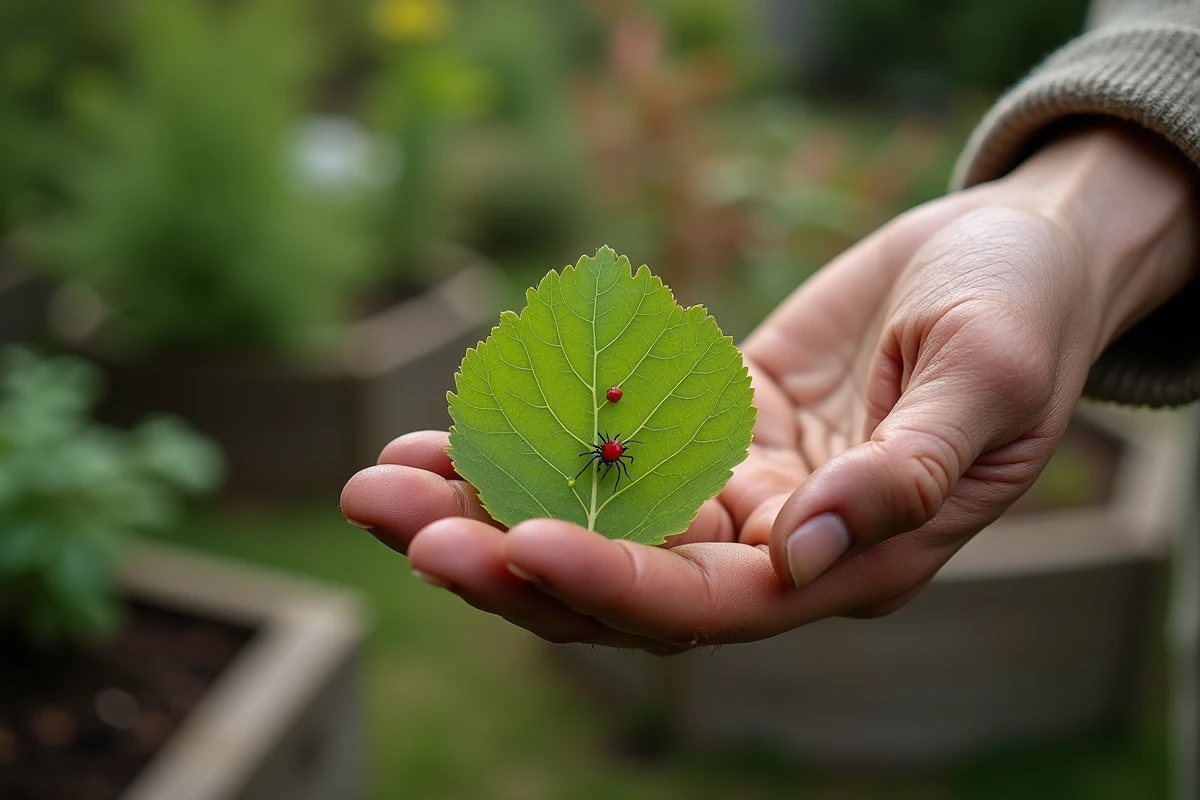
An isolated spider mite does not threaten a flowerbed. The danger arises when conditions allow it to reproduce rapidly.
Dry heat above 30 °C is the main accelerator. In a hot and dry atmosphere, the reproduction cycles shorten. A population can explode in a few days and devastate a vegetable garden, greenhouse, or perennial bed.
With the increased frequency of heatwaves, this scenario occurs more often than it did a few years ago. Garden greenhouses and south-facing balconies are the most vulnerable areas.
Spotting the first signs on your plants
The first clue is tiny discolored spots on the tops of the leaves. The leaf takes on a marbled appearance, then turns completely yellow.
If you turn the leaf over, you will see small webs and sometimes the mites themselves, barely visible to the naked eye. It is the translucent, spherical eggs that confirm the identification. Fine webs under the leaves indicate a spider mite, not a helper.
Natural management of harmful red mites in the vegetable garden and greenhouse
The good news: spider mites can be controlled without chemicals in most domestic situations. Chemical acaricides also eliminate predatory mites, which worsens the problem in the medium term.
Spraying and humidity
Spider mites hate humidity. Regularly misting the foliage slows their reproduction. In a greenhouse, maintaining a correct humidity level is often enough to prevent population explosions.
On a balcony or terrace, a simple spray of water on the underside of the leaves two to three times a week reduces pressure. The goal is not to drown the plant, but to create an unfavorable environment for the pest.
Black soap and natural predators
A diluted solution of black soap sprayed on the affected areas eliminates spider mites by contact. This method works on small surfaces: a few tomato plants, a rose bush, strawberry plants.
Introducing phytoseiids (predatory mites) remains the most effective method in a greenhouse. These helpers feed exclusively on spider mites and self-regulate when the prey disappears. They are available in sachets to hang on plants.
Velvet mites on walls and balconies: should we be concerned?
Red velvet mites are on the rise in urban and suburban areas. Climate change and the increasing mineralization of surfaces (terraces, facades, slabs) provide them with a favorable habitat.
Their presence on a white wall or hanging laundry can leave micro-red stains if crushed. This is their only real drawback. These velvet mites do not sting, bite, or attack plants.
To limit their numbers on a terrace without killing them, a simple spray of water is enough to dislodge them. They will likely return because warm, sunny surfaces suit them, but they cause no damage to the garden.
The right reflex when facing an unidentified red creature
Before taking action, observe where the mite is and how it behaves. A mite running on a wall or slab is almost always a velvet mite, thus a helper. A mite that is still under a leaf, surrounded by webs, is probably a spider mite.
- On a wall or mineral surface: do nothing, it’s a helper.
- Under the leaves with webs: monitor the situation, mist, treat with black soap if necessary.
- On a houseplant: isolate the pot, increase ambient humidity, inspect neighboring plants.
The short answer to the initial question can be summed up in one sentence: the majority of little red creatures in the garden are useful helpers. Crushing them by reflex deprives your garden of a natural pest regulator. Only spider mites, identifiable by their webs and damage to the foliage, justify intervention, and even then, water and black soap solve the problem without destroying the rest of the beneficial fauna.