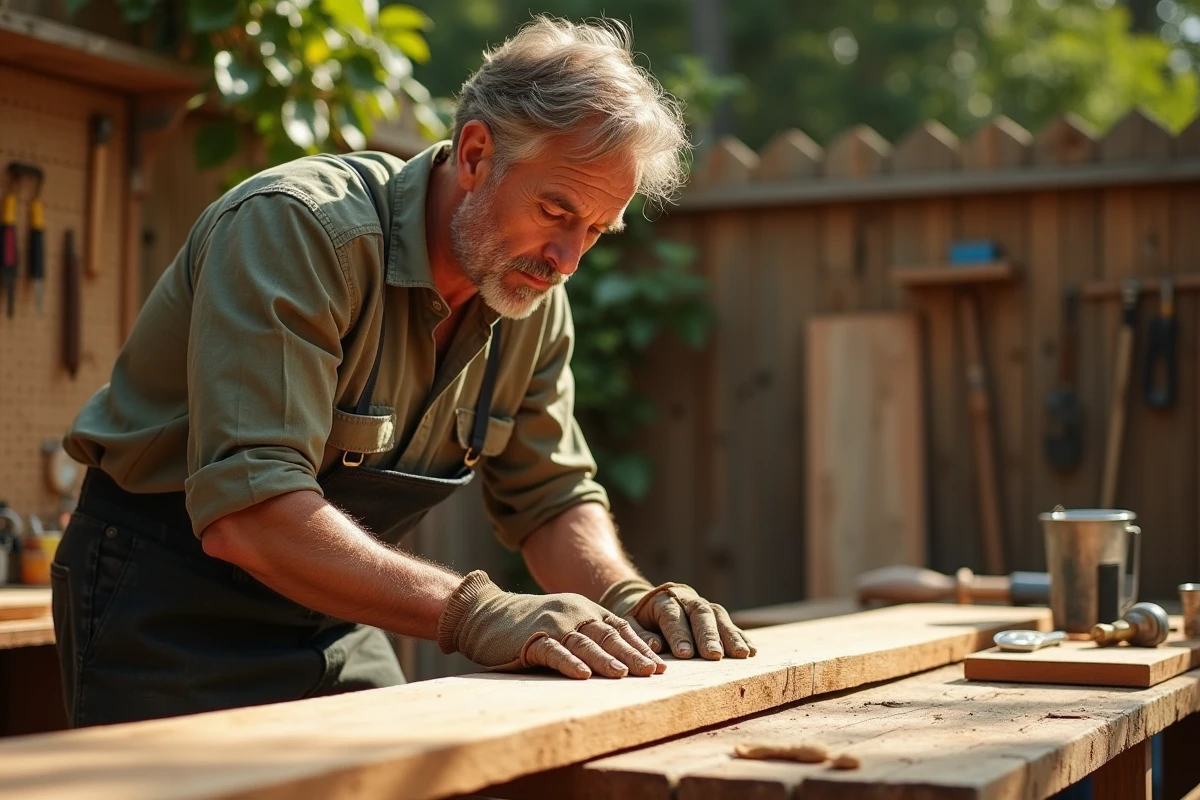
The choice of a wood species for outdoor use relies less on the label “decay-resistant” than on a thorough understanding of the EN 335 standard and usage classes. Many woods labeled as resistant do not live up to their promises in class 4, while underestimated species outperform some exotics. We review the technical parameters that truly matter.
EN 335 Standard and Usage Classes: The Real Filter for Durable Outdoor Wood
Talking about decay-resistant wood without referencing the EN 335 standard is like comparing species without a common criterion. This reference classifies exposure situations from 1 (dry interior) to 5 (permanent saltwater). For a terrace, cladding, or garden furniture, we work in class 3 or 4 depending on ground contact and water retention.
A naturally durable wood in class 3 can fail in class 4 if its density or extractable content is insufficient against prolonged wetting. Oak, for example, is suitable for vertical cladding (class 3b) but degrades faster in horizontal terrace boards with water stagnation.
The key point: the natural durability of a species (rated from 1 to 5 according to the EN 350 standard) must be cross-referenced with the targeted usage class. When browsing the list of decay-resistant woods, this distinction between intrinsic durability and targeted usage class makes all the difference between a structure that lasts twenty years and an early replacement.
Black Locust: The European Hardwood Replacing Exotic Woods
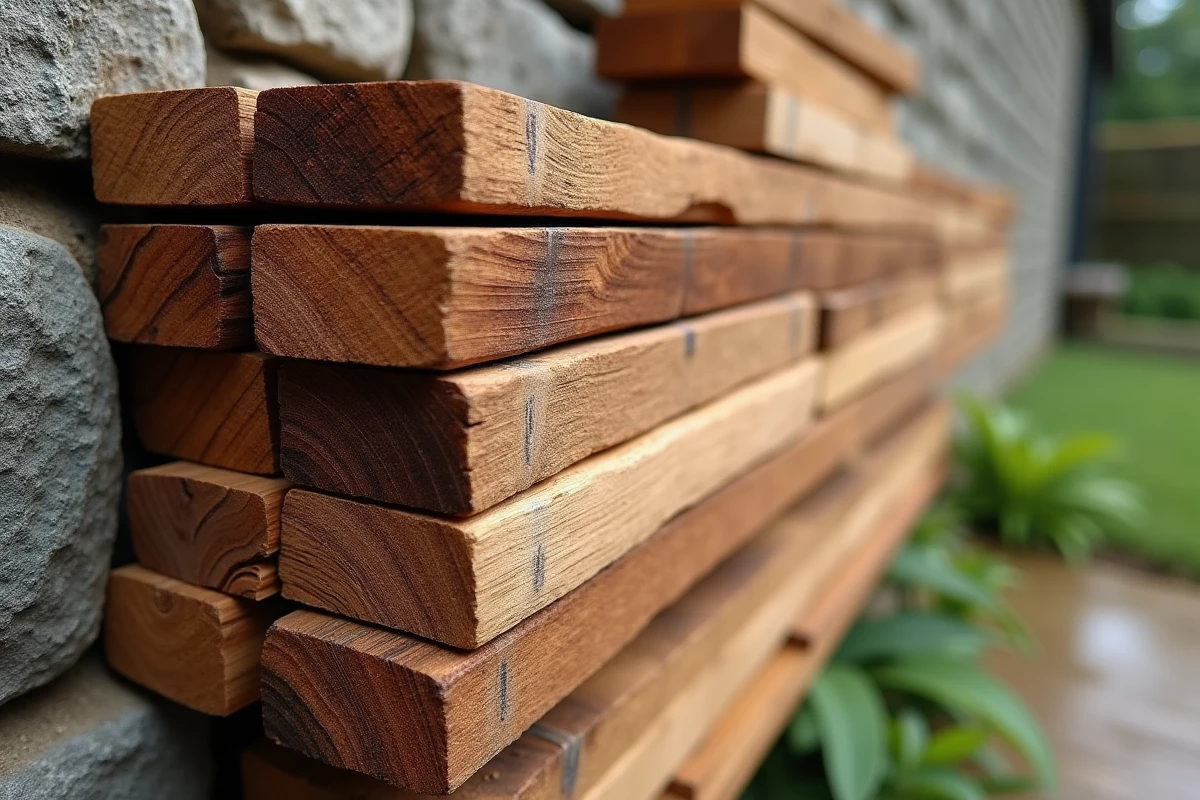
Popular articles consistently mention teak, ipe, or cumaru. However, black locust remains the only European hardwood to achieve a natural durability rating of class 1-2 in direct ground contact, without any treatment.
Its mechanical properties (bending, hardness) rival those of many tropical woods. It resists wood-decaying fungi and wood-boring insects due to a high concentration of flavonoids in the heartwood. In recent years, French architects and municipalities have increasingly integrated it for terraces, playgrounds, and agricultural stakes.
The ecological argument is straightforward: short supply chain, abundant local resource, no transoceanic transport. Black locust is the most credible European alternative to exotics for class 4.
Limitations to Know Before Specifying Black Locust
- The wood is prone to warping during drying, with marked tangential shrinkage. Poorly conducted drying can cause visible deformations on terrace boards.
- The sections available in trade are more limited than for pine or Douglas fir. Lengths exceeding three meters are difficult to source in consistent quality.
- Graying occurs quickly without maintenance, comparable to that of teak. A pigmented saturator is necessary to maintain the original honey hue.
Thermally Modified Woods: Thermo-Ash, Thermo-Pine, and Thermo-Spruce
The high-temperature thermal treatment (between 180 and 230 °C depending on the species) modifies the wood’s cellular structure without chemicals. The result: a durability that shifts from class 5 to class 3, sometimes class 2, sufficient for cladding and decking not in permanent contact with water.
Thermo-ash is the most common on the French market. Its dimensional stability after treatment exceeds that of treated pine, and its dark brown appearance is appealing in contemporary cladding. Thermo-pine and thermo-spruce offer more affordable alternatives, with slightly lower durability.
What Thermal Treatment Does Not Do
Thermal modification reduces the mechanical strength of the wood. In bending, the loss can be significant compared to untreated species. A thermally modified wood is not suitable for structural uses (load-bearing posts, terrace joists). We reserve it for terrace boards, cladding, and fences.
The other point of caution concerns class 4: a thermally modified wood in permanent contact with soil or stagnant water will degrade. For a raised terrace on pedestals, this is acceptable. For earth retention or pilings, it is necessary to opt for black locust, ipe, or class 4 treated pine.
Treated Pine, Douglas Fir, and Chestnut: Positioning Common Species
Autoclaved treated Scots pine class 4 remains the most economical choice for outdoor work in contact with the ground. The treatment with copper salts provides a reasonable artificial durability, but longevity depends on the quality of penetration of the product into the sapwood and heartwood.
The Douglas fir offers a natural durability rating of class 3. Its heartwood performs well in cladding and elevated decking. However, the sapwood (the lighter part) has no resistance: we recommend specifying “out of sapwood” for any exposed use.
The chestnut is rated with a natural durability of class 2. Rich in tannins, it naturally resists fungi. It is suitable for decking, fencing, and cladding, with an interesting quality-price ratio compared to exotics. Its limitation: the frequent presence of checks (cracks between growth rings) on large diameter logs, which requires rigorous sorting.
- Autoclaved treated pine class 4: direct ground contact, tight budget, regular maintenance against graying.
- Douglas fir out of sapwood: cladding, decking on joists, without permanent ground contact.
- Chestnut: decking, fencing, stakes, good durability without chemical treatment.
- Larch: close to Douglas fir in durability, appreciated in cladding for its pinkish hue that grays uniformly.
The choice between these species is made based on three intersecting criteria: the actual usage class of the project, the overall budget (supply and installation), and the acceptance or not of natural graying. A wood that grays is not a wood that rots, and this confusion remains the primary source of premature replacement on outdoor sites.