A newborn sleeps, eats and needs changing. Their first few weeks revolve around these three needs. Yet the list of equipment for welcoming a baby home can quickly grow until it feels overwhelming. Focusing your purchases on what you’ll need as soon as you return from the maternity hospital, and leaving the rest for later, helps you spend wisely and adapt to your family’s actual routines.
Purchases to put off: what your baby won’t use in the first few weeks
Before discussing what to buy, it’s worth looking at what can wait. Many parents accumulate equipment that stays in its box for months.
A high chair, for example, isn’t useful until your child can sit up, usually around six months. A lightweight stroller is only suitable once your baby can hold their head up. Elaborate developmental toys are of little use to a newborn who can barely distinguish between contrasting shapes.
Putting off a purchase lets you make an informed choice. After a few weeks, parents know whether their home is better suited to a baby carrier than a bulky stroller. They also know whether breastfeeding is working or whether they need a full set of bottle-feeding equipment. Online catalogues, such as the one available at https://pausebebe.com, make it easy to compare options once you’ve clarified what you need.
Setting aside some of your budget for the second or third month helps avoid duplicate purchases and decisions driven by prenatal panic.
Newborn bed, mattress and sleep space
Sleep takes up most of a newborn’s day. This is one area where you shouldn’t improvise.
Which bed to choose from birth
There are three options: a cradle, a cot and a bedside crib. A cradle is compact, making it a good fit for small bedrooms or the living room. A cot, on the other hand, can be used until your child is two or three years old. A bedside crib attaches to the parents’ bed and makes night-time wake-ups easier, especially when breastfeeding.
A firm mattress that fits the bed exactly is an absolute priority. There should be no gaps between the mattress and the sides. Cot bumpers, pillows and soft toys don’t belong in the sleep space: they increase the risk of suffocation.
Temperature and sleep environment
The room should ideally be kept between 18 and 20 °C. A room thermometer is all you need to check. A sleep sack replaces a blanket and can be adapted to the season with different thicknesses (measured in TOG). For the first few weeks, one or two newborn-size sleep sacks should be enough.
Changing and bathing essentials for the first few months
Diaper changes happen several times a day. Your setup should be practical, stable and within easy reach.
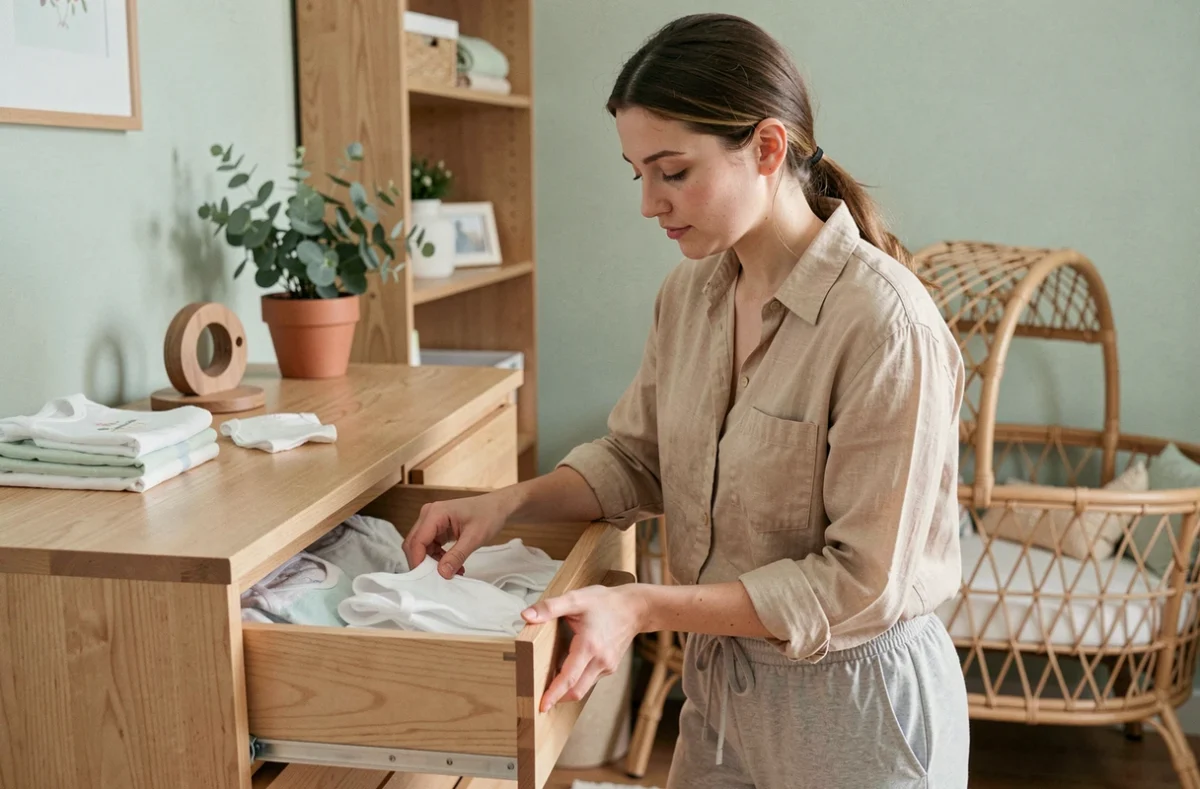
- A changing table or simply a changing mat placed on a sturdy dresser. The surface should be at waist height to protect the parent’s back.
- Enough diapers for the first week (allow around ten a day for a newborn). You can decide between disposable and cloth diapers after trying them for a few days.
- Liniment or a gentle cleanser, cotton pads or reusable wipes, and diaper cream for irritation.
- A rigid baby bath or a bath seat. Daily baths aren’t necessary: two to three baths a week are enough for a newborn, with a washcloth used in between.
A bath thermometer ensures the water is between 36 and 37 °C. This inexpensive accessory helps you avoid guesswork.
Feeding your baby: choose equipment to suit your feeding method
Have you decided whether to breastfeed, bottle-feed or combine the two? Your answer will shape your shopping list, though it may still change after the birth.
If you’re breastfeeding
You’ll need very little equipment: two or three nursing bras, breast pads and, if you like, a nursing pillow for a more comfortable position. You can rent a breast pump from a pharmacy instead of buying one, giving you a chance to try the model before committing.
If you’re bottle-feeding
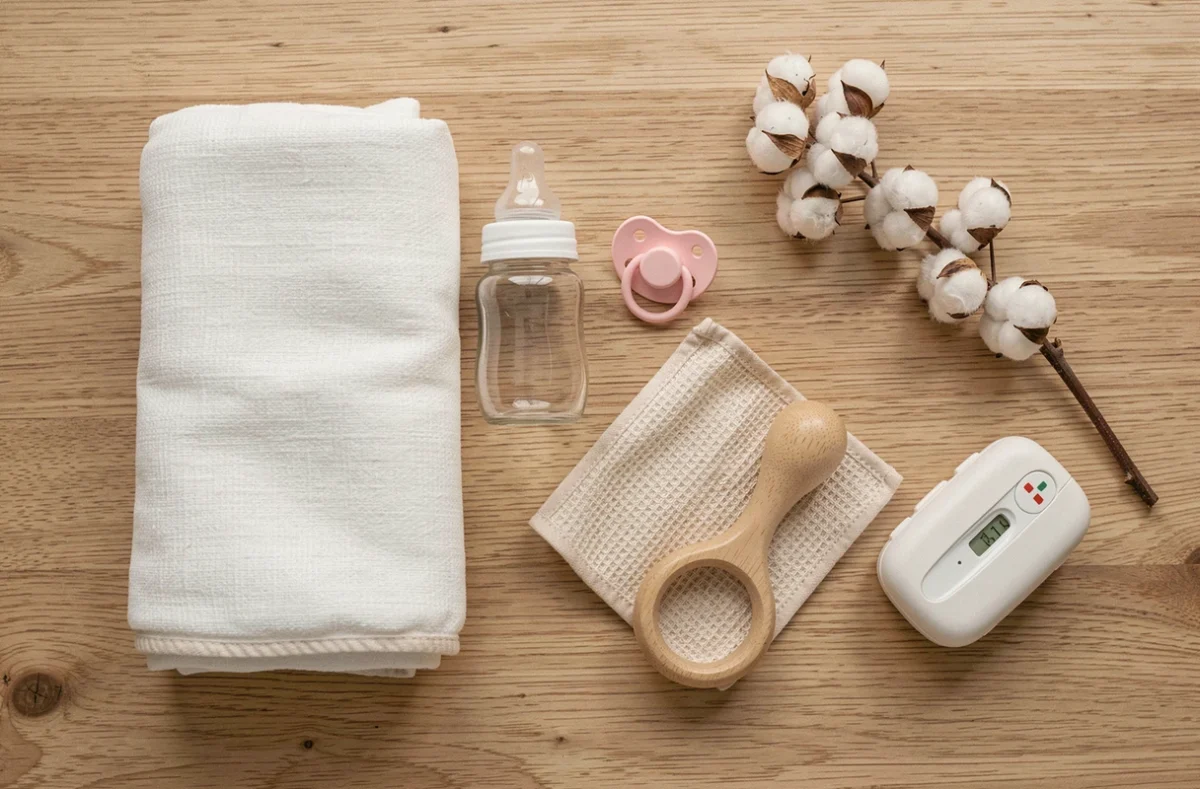
Start with four to six small bottles and slow-flow newborn teats. A bottle brush makes cleaning easier. A steriliser is optional: according to most current paediatric recommendations, thorough washing with hot water and dish soap is enough.
Limit your supply of first infant formula to one or two tins. Some newborns don’t tolerate every formula, and your paediatrician may recommend a different one at the first check-up.
Car seat and getting around: the one essential purchase before birth
A Group 0 (or 0+) car seat is the only piece of equipment parents must have before arriving at the maternity hospital. Without one, you can’t bring your baby home by car.
Choose one based on your vehicle (check whether it’s compatible with Isofix or a seat belt) and your baby’s estimated birth weight. Buy a car seat new, or use a second-hand one only if it has never been in a collision. Even after a minor accident, the internal structure may be compromised without any visible signs.
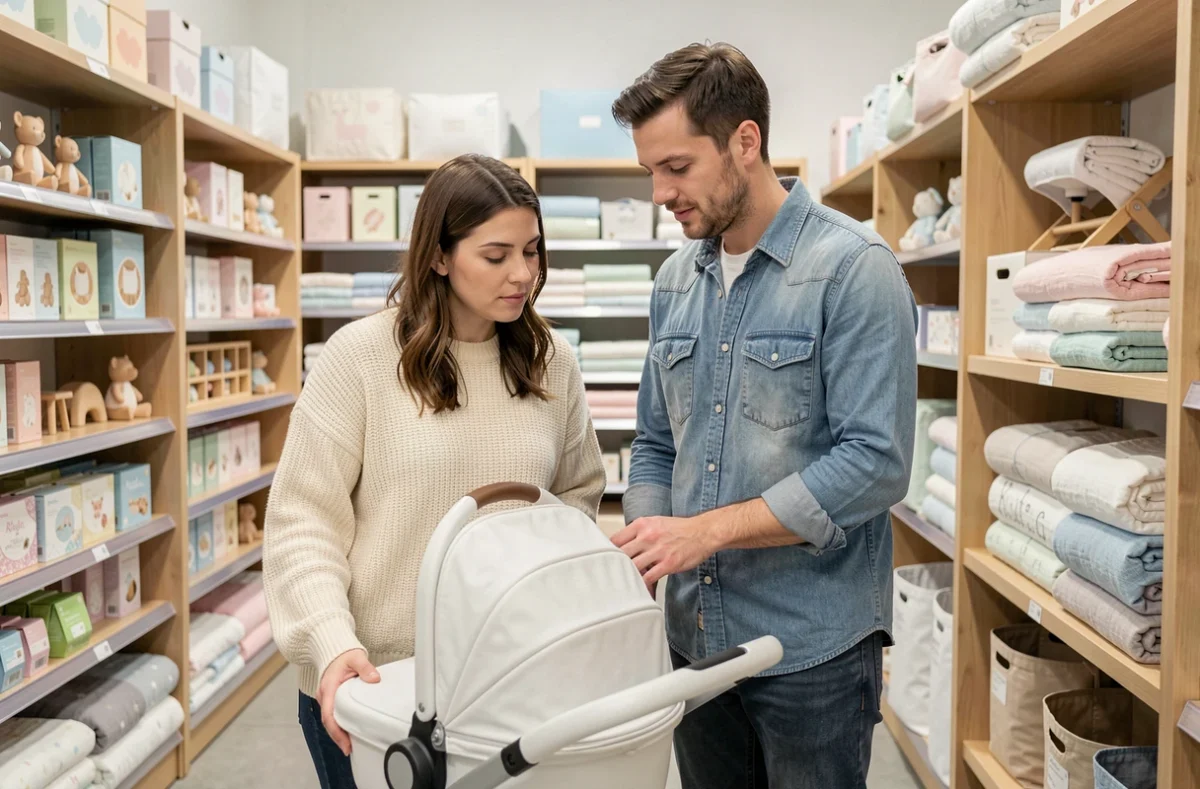
A stroller, on the other hand, can wait. For their first outings, many parents use an ergonomic baby carrier or a wrap, which are more practical for a newborn who needs to stay close. If your home has narrow stairs or no lift, babywearing is a natural choice before getting a stroller.
Baby clothes and newborn essentials: realistic quantities
Newborns grow quickly. Buying too many clothes in newborn size means some may never get worn.
- Six to eight bodysuits, half in newborn size and half in 1-month size, to cover both possible birth-weight scenarios.
- Four to six cotton sleepsuits, with front openings or poppers to make night-time changes easier.
- Two lightweight hats, a pair of socks or soft booties, and a cardigan or jacket depending on the season.
- Two or three bibs and a pack of muslin cloths, useful for spit-up and as an improvised mattress protector.
Wash clothes before their first use with a gentle, fragrance-free detergent. Second-hand clothes are a sensible option for sizes worn for only a few weeks, as long as you check that the poppers are in good condition and the fabric isn’t excessively fluffy.
Keeping your initial layette small leaves room for gifts from family and friends, who often give clothes. It’s better to let them know which sizes you still need than to end up with ten outfits in newborn size that never get worn.