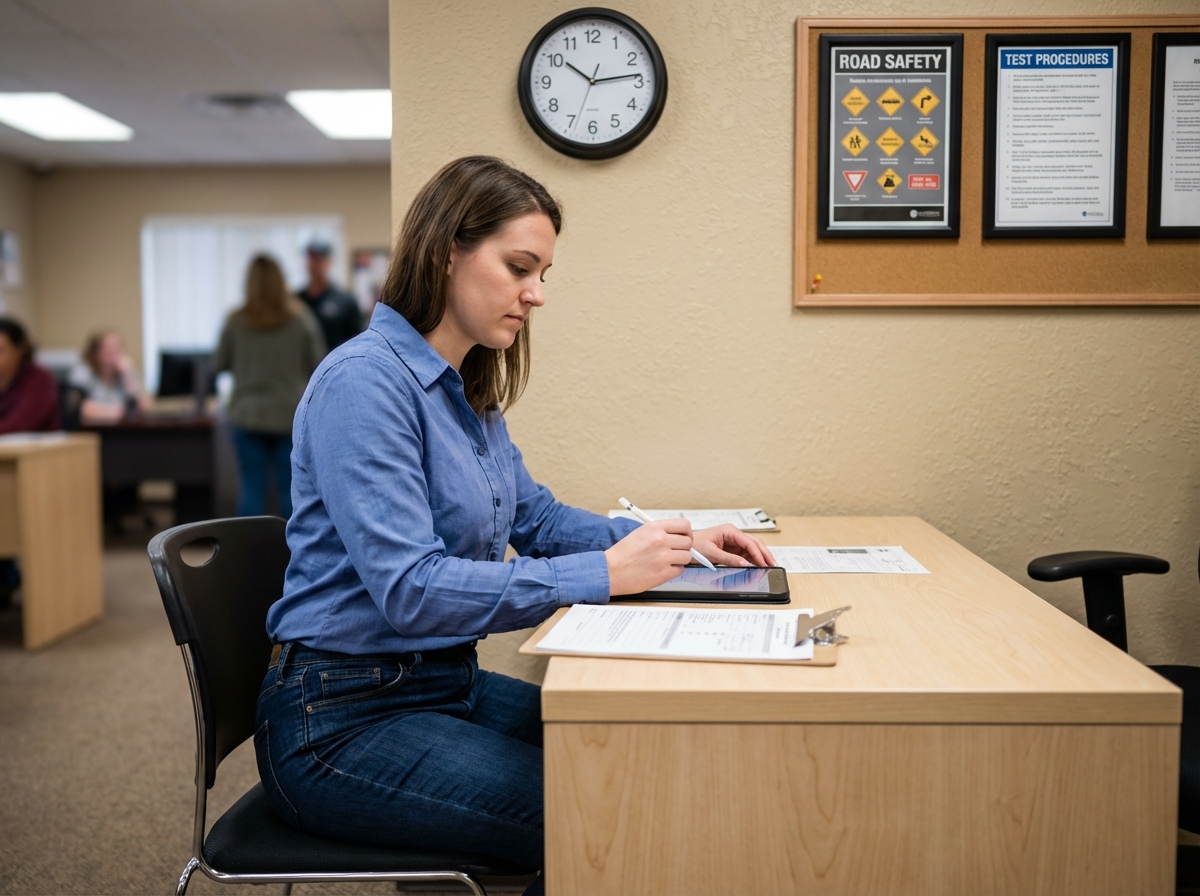
Obtaining a driver’s license after a cancellation is not just about a new practical or theoretical exam. An intermediate step requires, in some cases, passing specific psychotechnical tests. Their goal goes beyond simply assessing road knowledge.
People often misunderstand the significance of this mandatory step, which follows strict regulations and targets profiles that are much more varied than just sanctioned drivers. These evaluations disrupt habits, as they concern both the safety of everyone and each individual’s ability to get back behind the wheel. It is impossible to hope for success by preparing for it as if it were just a simple code test.
What are psychotechnical tests for and why are they essential?
Psychotechnical tests are not merely a bureaucratic checkbox. Their mission is to verify that the person aspiring to regain or retain their driver’s license can react with discernment and speed on the road. Two axes guide these tests. On one side, reactivity, attention management, and coordination are measured. On the other side, the actual ability to resume driving after a suspension, cancellation, or invalidity of the license is examined.
The psychologist plays a central role. They conduct an interview to understand the personality, gauge the ability to handle pressure, and measure risk awareness. Candidates then undergo timed exercises designed to test logic, memory, and reaction speed. The psychotechnical test thus becomes a real barrier: it filters, protects road safety, and eliminates high-risk profiles.
It is impossible to bypass this step: every driver subject to a suspension or cancellation must provide a positive medical opinion, issued after meeting the test requirements. Without this approval, there is no return to the license, even with good results on the standard exam. In Perpignan, the procedure is exemplified by the psychotechnical test in Perpignan, which adheres to both local and national standards. This system adjusts its approach according to the situations while maintaining a rigorous standard, both scientific and human, in the service of everyone’s safety.
But the usefulness of psychotechnical tests does not stop at the road. In the workplace, employers and recruiters use them to assess the aptitude and reliability of candidates. This proves that psychotechnical evaluation extends far beyond the scope of the driver’s license.
Process and forms of psychotechnical evaluations in the context of driving
Before resuming driving after a suspension or cancellation, the psychotechnical test is mandatory. It is organized in two main phases: an individual interview and a battery of standardized exercises. Guided by a certified psychologist, the interview explores the candidate’s personality, stress management, and understanding of driving risks. A sincere exchange is expected here, capable of revealing the ability to self-reflect.
The second phase involves completing psychotechnical exercises on a computer or on paper. The methods vary, but the objective remains the same: to assess concentration, memory, logic, and eye-hand coordination. The exercise is never rushed: the pace is fast, and the duration exceeds forty minutes. There is no hiding; every hesitation or reaction is noted. The classic tests involve logical sequences, dominoes, cards, or progressive matrices.
Here are the main categories of tests to expect during this evaluation:
- Attention tests: They measure the ability to stay focused, even in monotonous conditions or under pressure.
- Reaction tests: They evaluate the quickness of reflexes, a decisive quality for anticipating the unexpected on the road.
- Reasoning tests: They allow for judging the ability to solve unknown situations.
- Memory tests: They check the ability to retain information useful for driving.
At the end of this procedure, the psychologist delivers their verdict: a favorable or unfavorable opinion, which governs the next steps. The validity of the test does not exceed six months, and each assessment must take place in an approved center, ensuring the impartiality of the process.

Feeling ready on the day: practical tips for approaching the test calmly
Taking a psychotechnical test is also an exercise in introspection. Preparing mentally means putting all the odds in your favor. It is better to arrive rested: regular sleep in the days leading up helps keep the mind sharp, as concentration and speed depend on it.
On the morning of the evaluation, adopt a reassuring routine. A complete meal, rich in proteins and slow carbohydrates, stabilizes energy. Opt for simple, comfortable clothing to avoid any discomfort or unnecessary distraction. Planning to arrive early at the approved testing center minimizes unnecessary stress related to rushing.
To optimize your chances, there are concrete solutions. Online resources dedicated to psychotechnical test preparation offer the opportunity to practice logic, attention, or reaction tests. It is useful to practice speed reading, time management, and answer precision. Personal organization makes a difference: plan your revisions, identify your weak points, and set regular times to practice.
To manage pressure, several simple techniques are at hand. Breathe deeply, visualize a positive outcome, and allow yourself brief breaks if possible. On test day, keep in mind that the psychologist is not trying to trap you, but to assess your abilities in realistic conditions. Staying true to yourself and accepting the unexpected is already a step in the right direction.
At the end of the journey, the psychotechnical test is not just an administrative hurdle: it invites you to know yourself better while giving a real chance to get back on the road on solid foundations.